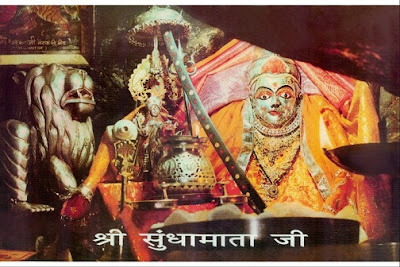
Sundha Mata

Jai Sundha Mata

Sundha Mata temple is about 900 years old temple of Mother goddess situated on a hilltop called 'Sundha', located at Longitude 72.367°E and Latitude 24.833°N, in Jalore District of Rajasthan. It is 64 km from Mount Abu and 20 km from the town of Bhinmal.

Tanot Mata Mandir

Tanot Mata Temple, about 180 Kms from Jaisalmer near Pak Border. Tannot Mata is a temple in western State of Rajasthan in District Jaisalmer of India. The Village is close to border with Pakistan and is very close to the battle site of Longewala of Indo-Pakistani War of 1971.

Sundha Mata

Sundha Mata temple is about 900 years old temple of Mother goddess situated on a hilltop called 'Sundha', located at Longitude 72.367°E and Latitude 24.833°N, in Jalore District of Rajasthan. It is 64 km from Mount Abu and 20 km from the town of Bhinmal.

Jai Sundha Mata

Sundha Mata temple is about 900 years old temple of Mother goddess situated on a hilltop called 'Sundha'.

This is default featured post 5 title

PGo to Blogger edit html and find these sentences.Now replace these sentences with your own descriptions.This theme is Bloggerized by Lasantha Bandara - Premiumbloggertemplates.com.

Friday, September 30, 2011

Sketch of: 10 Avatars of Vishnu

10 Avatars of Vishnu !!!


Source: http://sanchivarma.blogspot.in/2011/02/10-avatars-of-vishnu.html
(courtesy of Sachit)
BUDHHA
In BUDDHA Avatar, Lord Vishnu incarnates himself as BUDDHA, the ascetic prince who renounced the throne to lead the world on the path of peace. He is the founder of the BUDDHIST religion prominent across the world. In certain sects of Hinduism, he is considered to be a divine incarnation of Lord Vishnu. He was born the crown prince of the Kapilavastu to Suddhodana and Maya. He was named Siddhartha, meaning "All thing fulfilled" by the king. But his mother died soon after his birth but Prajapati, the sister of
Maya, brought Siddhartha up.
Buddha was saddened by death of living creatures, since his childhood days and used to question:
"Alas! Do all living creatures kill each other?". He wasn't happy with any answers that were provided
to him and he decided to find out the meaning and the absolute truth and he left his wife and child to a hermit's life in the forest and one day, became the enlightened one. His preachings spawned off the religion of Buddhism now popular across the whole world.

KALKI
In KALKI Avatar, Lord Vishnu will incarnate himself as KALKI, the machine-man, who will come riding his white horse and with his blazing sword in his hands. This is supposed to be a future avatar of Lord Vishnu. At the end of Kali Yuga (present eon) He will punish all evil doers in this world, destroy this world supposedly and recreate a golden age again. KALKI is the last of the avatars of Lord Vishnu.
KRISHNA
In KRISHNA Avatar, Lord Vishnu incarnates himself as KRISHNA , the central character in the epic MAHABHARATA. In this biggest epic of Indian mythology a myriad of topics are covered, including war, love, brotherhood, politics etc. It is essentially the story of two warring groups of cousin brothers, the PANDAVAs and the KAURAVAs. As a part of the Mahabahrata, during the war KRISHNA, gives a long discourse to his disciple ARJUNA, collectively termed as Bhagvad-Gita. Krishna, during his child-hood was responsible for the killing of Kansa. Krishna is also considered to be an ultimate playboy who was resonsible for charming all gopikaas(cowherdesses) around him. Unlike Ramayana, Mahabharata deals with more down to earth issues like politics, human nature, human weaknesses, and does not attempt to idealise the characters as in RAMAYANA
KURMA
In KURMA Avatar, Lord Vishnu incarnates himself as a tortoise. It is an interesting story involving both the gods (Devtas) and asuras (demons). In the ongoing saga of battle between the gods and asuras, on one occasion the gods suddenly lost all their strength due to a curse by the short-tempered sage
Durvasa. The sage had once presented a garland of flowers to Indra,king of gods, who carelessly gave it away to his elephant which trampled it. The Devtas approached Vishnu for help. Vishnu then asked them to churn the ocean of milk after adding medicines into the ocean. Mt Mandara could be used a the churning stick he said. He requested them to ask them help of Asuras in lifting the mountain in exchange for offer of the share of nectar of immortality that would ensue from the churning. Both the devatas and the asuras churned
the ocean using the serpent Vasuki as the rope. At the start, playing a Machiavellian trick, Indra, king of the gods asked the asuras for the head end of vasuki.
But asuras suspecting foul play, took the head end, only to be deceived as the poison from Vasuki was slowly weakening them. But as churning was proceeding the mountain was sinking and then Lord Vishnu took the form of the tortoise KURMA and kept the mountain afloat. As soon as the bowl of amrita, the nectar of immortality was out, the asuras grabbed it. Then Lord Vishnu took the form of an apsara, a beautiful maiden, and seduced the asuras into letting her distribute the nectar and also to abide by her order of distribution. As soon as the devatas were served the maiden disappeared thus totally deceiving the asuras and making them totally weak.

MASTYA
In MASTYA Avatar, Lord Vishnu incarnates himself as a fish in this world. In the earliest yuga (era) of Sata-yuga, a king named Manu was performing severe penance for thousands of years. One day as he was
performing ablutions with river water, a small fish came into his hands and just as he was about to throw the fish back into the river, the fish requested the king to save its life. Heeding its request, the king put
the fish into a jar of water but the fish started growing and the jar was not big enough for it. Then the king threw it into the river, but it soon it outgrew the river and the king then threw it into Ganges and then into the ocean.The king realised that it was Lord Vishnu himself and then the lord made an appearance and made a special request to the king. It predicted that the world would come to an end by a huge flood in seven days and requested the king to build a huge boat and take the seven sages(hermits), seeds of all plants, one animal of each type and told him that he would appear as a fish to propel the boat to Mt Himavan for surviving the flood to the next yuga(eon). True to his word, after seven days the Lord appeared and the king tied the boat to the fish by using the royal serpent Vasuki and the fish took all of them to Mt Himavan and kept them there till the flood was over and in the new era, the king started procreation a for the new era.

NARASIMHA
In NARASIMHA Avatar, Lord Vishnu incarnates himself as a semi-man,semi-lion in this world. The king of demons(asuras), Hiranyakasyapa, wanted to become immortal and wanted to remain young forever. To this end, he meditated for Lord Brahma and because of his severe penance, the gods were frightened and asked Brahma to pacify the king. Brahma was impressed by his austerity and granted him a wish. HiranyaKasyapa wished that he be neither killed by a man or beast, nor in daylight or at night and neither inside or outside a building.
Having obtained the wish he considered himself the supreme God and frobade all worship of gods by anyone. But his son Prahlada, was an ardent devotee of Vishnu. This enraged Hiranyakasyapa very much. He ordered numerous ways to kill Prahlada including asking his sister Holika to sit with Prahlada in the fire. But everytime Prahlada escaped unhurt. Enraged, once he asked Prahlad to show him the Lord Vishnu. Prahlad said, "He is everywhere". Further enraged, Hiranyakasyapa knocked down a pillar, and asked if Lord was present there. Lord Vishnu then emerged as a half lion, half man from the pillar which was neither inside the house nor outside, and the time was evening, neither night nor day. He then killed Hiranyakasyapa thus saving the life of his devotee Prahlada.

PARASURAMA
In PARASURAMA Avatar, Lord Vishnu incarnates himself as a brahmana(priest) in this world. He was brought in this world to avenge all kshatriyas who had become arrogant and were suppressing the brahmans in the world. He was born to Jamadagni and Renuka, and belonged to the Brighu clan. Parashurama was always carrying an axe presented to him by Lord Shiva of whom he was an ardent devotee.
Kartavirya a powerful king, once went to Jamadagni's home when he was out, and after a meal, stole the Kamadhenu cow, which was supposed to give endless quantity of milk. Jamadgni was enraged and he went and killed the king and brought Kamadhenu back. On hearing this the son of the king came back and killed Jamdagni.Parasurama was enraged at this and went and avenged the death of his father by killing all kshatriyas in 21 battles. His story is story of the supremacy of brahmans over the kshatriyas.

RAMA
In RAMA Avatar, Lord Vishnu incarnates himself as RAMA , the central character in the epic RAMAYANA. In this biggest epic of Indian mythology a myriad of topics are covered, including war, love, brotherhood,ideal man , son etc. It is essentially the story of an ideal king, son, father and man, RAMA. As an ideal son, he agrees to abide by wishes of his father King Dasaratha to spend 14 years in forest, along with his wife Sita and brother Lakshman. During the course of his stay in forest, the demon Ravana abducts his wife Sita. Ram then sets out in search of his wife. During this he makes friends with king of monkeys Sugreeva, and his devotee Hanuman. In the end he wages a war with Ravana and rescues Sita to return to Ayodhya and rule it as an ideal king for 1000 s of years.
VAMANA

In VAMANA Avatar, Lord Vishnu incarnates himself as a dwarf priest in this world. BALI, the grandson of Prahlada was a very valorous and mighty asura. By his penance and might, he conquered the whole world. Indra and other gods fearing that he and asuras would conquer all the three worlds, went to Lord Vishnu for help. Lord Vishnu was then born as a dwarf Vamana in the household of a brahmana(priest).
He went to Bali on growing up and asked for alms. Bali was delighted to offer him anything he requested even though his priest warned him that it was Lord Vishnu.

Vamana then requested for the amount of land that could come under his three feet. Bali gracefully agreed. Lord Vishnu then grew in size and covered the earth and heaven in two stride. And due to lack of space,
he put his third leg on Bali himself and crushed Bali to the nether or the Patala loka(underground world), thus helping the Gods out.

VARAHA

In VARAHA Avatar, Lord Vishnu incarnates himself as a boar in this world. A demon Hiranyaksha, had prayed for Lord Brahma and got awarded a boon that no beast nor man nor god could kill him. But somehow from the list of beasts the name of boar was missing. This proved to be his lacunae. He then started a campaign of plunder across the worlds. He pushed the world to the Pataal loka, or the under of the sea. He stole the Vedas, the holy scriptures from the Lord Brahma, while he was asleep and performed huge atrocities.
To retrieve the Vedas and to save the world the Lord Vishnu assumed the role of a boar and brought out the earth from the under of the ocean, using its two tusks. It then killed Hiranyaksha and retrieved the Vedas from the asura and brought it back to the safe custody of the Lord Brahma.


Soure: http://sanchivarma.blogspot.in


Sketch of : The 9 Avatars of Goddess Durga

The 9 Avatars of Goddess Durga
 

Source: http://sanchivarma.blogspot.in/2011/02/9-avatars-of-goddess-durga.html
(courtesy of Sachit)
Navratri or Navratra iteslf means nine days. Its the festival of worshipping Goddess Durga Mata in her nine swarups. Each day of Navatri represents one of the following nine swarups of Durga Mata.
1. Mata Shailputri

"Shail" means mountains and "putri" means daughter. Ma Shailputri means daughter of mountains and this swarup refers to Goddess Parvati who was the Daughter of King Himavan
(the King of the mountains). Ma Shailputri is depicted with two hands, one with a trident and the other with a lotus. She is seated upon a bull. She is believed to be an embodiment of the power of Brahma, Vishnu and Shiva. In her previous incarnation, Shailputri is believed to be Sati, the daughter of Daksha and the wife of Lord Shiva. Once Daksha had organized a big Yagna and did not invite Shiva. But Sati being obstinate, reached there. Thereupon Daksha insulted Shiva. Sati could not tolerate the insult of husband and burnt herself in the fire of Yagna. In other birth she became the daughter of Himavan, the king of the Himalayas in the name of Parvati - Hemvati and got married with Shiva once again. Mata Shailputri or Ma Parvati can be worshipped at any temple of Shivji where her deity is always present next to her consort God Shiva.

2. Mata Brahmacharini

The second Durga Shakti is Brahamcharini. Brahma that is who observes penance(tapa) and good conduct. She is depicted with prayer beads in her right hand and Kamandal in left hand. Legend states that in a previous birth she was Parvati /Hemavati the daughter of Himvan. Once when she was busy in games with her friends,Naradaji came to see her and on reading her hand/palm-lines Narad Muni stated that, "You will get married with a naked-terrible 'Bhole baba' who was with you in the form of Sati, the daughter of Daksh in previous birth. But now you have to perform penance for him." There upon Parvati told her mother Menaka that she would marry none except Shambhu, otherwise she would remain unmarried. Saying this she went to observe penance. That is why her name is famous as tapacharini - Brahmacharini. From that time her name Uma also became familiar.
‘Brahma’ here refers to the meditative aspect of Brahmacharini and is always depicted as pious women or Sannyasin. She is also worshipped as goddess Tara and is associated with the pious form of Goddess Shakti. She is believed to be that aspect of Mother Goddess, which was present in Sati and Goddess Parvati, when they both did intense austerities to get Lord Shiva as husband. During the penance Mata Parvati did in order to gain Lord Shivji as her consort for thousands of yrs. without eating even leaves she penance so she was called 'Aparna'. Seeing her body her mother uttered U-ma and so she is also called 'Uma'. Her worship increases sacrifice,good deeds & restraint in humans. Rudraksha is her most adorned ornament.
In some regions, Goddess Chamunda swarup of Durga is worshiped on the second day of Navratri. In this form she is believed to have killed the demons Chanda and Munda.There is a famous Chamunda Mata temple at Jodhpur.

3. Mata Chandraghanta

Chandraghanta Ma is known and named Chandraghanta or Chandra-Khanda for the semi-circular moon (Chandra) which appears like a bell (Ghanta) on her forehead. Durga is also worshipped as Ashtamukhi and Shorashi in different parts of India on this day. She is depicted as having three eyes and ten hands holding with ten types of swords - etc. weapons and arrows etc. and is seated on a lion (in some photos on a tiger) and shown as ready for going to war. She is the image of bravery. The frightful sound of her bell terrifies all villains and demonic incarnations. She is also the giver of supreme knowledge and bliss and is depicted as having golden skin with the half circular moon on her forehead, glowing. Her ten hands hold .........
She is worshipped in this form in Kanchipuram (Tamil Nadu) India.Srisailam Devasthanam also is a temple of Ma Chandraghanta.A very popular legend associated with Ma Chandraghanta is the story of Raja Harischandra her devotee.

4. Mata Kushmanda

On the fourth day Mata Durga is worshipped as her Ma Kushmanda swarup. She is depicted as seated on a lion, and possesses eight arms. She resides in solar systems and represents all knowledge. Seven types of weapons are shown in seven hands and prayer beads in her right hand. She likes the offerings of "Kumhde." Therefore her name "Kushmanda" has become famous.
She is also known as 'Krishnamanda' and is believed o have created the universe,so she is called as Adi Swarup. She is also called 'Astbhuja'. Worship of Ma Kushmanda brings light into darkness and ignorance, gives true knowledge,destroys ego, disease, sorrow, depression, ignorance. "Kumbh Bhand" means to see cosmic vivacity in Pindi shape or knowledge of cosmic intricacies in human race. The abode of Mata Kushmanda is in Bhimaparvat.

5. Mata Skandmata

She is the Goddess of Fire. The fifth swarup of Ma Durga is "Skanda Mata". The daughter of Himalaya, after observing penance got married with Shiva. She had a son named "Skanda." Skanda is a leader of the army of Gods. Skanda Mata is a deity of fire. Skanda is seated in her lap. She has three eyes and four hands. She is white and seated on a lotus.
Some also depict her sitting on a lion with her son Skand ( Lord Kartikeya) in her lap with two hands holding lotuses while the other 2 hands respectively display defending and granting gestures. Its said, by the mercy of Ma Skandmata, even the idiot becomes an ocean of knowledge. The great and legendary Sanskrit Scholar Kalidas created his two masterpieces works viz. "Raghuvansh Maha Kavya" and "Meghdoot" by the grace of Ma Skandmata.However some believe Kalidasa was also inspired and blessed by Ma Kushmanda.

6. Mata Katyayani

The goddess of Vrindavan, she is depicted as having four arms and three eyes, she is seated on a lion. She is the sixth swarup of Ma Durga and is known as Mata Katyayani. The son of "Kat" was "Katya". Rishi Katyayan was born in this "Katya" lineage. Katyayan had observed penance with a desire to get Ma as his daughter. As a result she took birth as a daughter of Katyayan. Therefore her name is "Katyayani" . She killed the demon Mahishasur.To get Krishna as a husband gopis worship Ma Katryayani in Vraj. So she is established as the Queen of Vraj.

7. Mata Kaalratri


The seventh swarup of Ma Durga is Mata Kalratri. She is black like night. Her Hair is always shown as pitch black, long, loose and scattered . She has put on necklaces shining like lightening and human skulls. She has three eyes and is also shown as being seated on a Shava (dead body). 2 of her hands hold a cleaver and a torch, while the remaining 2 are in the mudras of "giving" and "protecting". Her vahana is a faithful donkey. The destroyer of darkness and ignorance, Mata Kaalratri is scourer of darkness; enemy of darkness.Mata Kaalratri's shrine is in Calcutta, India This four-armed swarup of Ma Durga dissipates darkness from amidst her devotees, and bestows freedom from fear and adversity. She is also called "Shubhamkari."When she breathes fire comes out of her nostrils.Any type of fear goes away by her worship. Shubhankari Mata always give 'Subh' good fruits.

8.Mata Mahagauri


She is like an eight-year-old girl. She is intelligent and peaceful, possesses three eyes and four arms, and uses the bull as her vehicle.The Eighth swarup of Ma Durga is Ma "Maha Gauri." She is depicted as fair as a conch, moon and jasmine flowers. Her clothes and ornaments are white and clean. She has three eyes. She rides on bull She has four hands. The above left hand is in "Fearless - Mudra" and lower left hand hold a "Trishul." The above right hand has tambourine and lower right hand is in blessing style. She is calm and peaceful. It is said that when the body of Gauri became dirty due to dust and earth while observing penance, Shiva makes it clean with the waters of Gangas. Then her body became bright like lightening. There fore, she is known as "Maha Gauri" .
She is also worshipped as Ma-Ambaji, Ma-Kalika, Ma-Bahucharaji. Ma Mahagauri can be seen in a temple at Kankhal near pilgrim centre Haridwar, India

9.Mata Siddhidratri


The Ninth Swarup of Ma Durga is Mata Siddhidatri. There are eight Siddhis or accomplishments, they are- Anima, Mahima, Garima, Laghima, Prapti, Prakamya, Iishitva & Vashitva. Maha Shakti gives all these Siddhis. It is said in "Devipuran" that the Supreme God Shiv got all these Siddhies by worshipping Maha Shakti. With her gratitude the half body of Shiv has became of Goddess and there fore his name "Ardhanarishvar" has became famous. This swarup is depicted as seated on a lion and has four hands. She is the giver of all forms of accomplishments[Siddhis].As per the Brahmavaivart Purana there are 18 types of achievements which are Anima, Mahima, Garima, Ladhima, Prapti, Prakaamya, Ishitva,Vashitva, Sarvakaamaal, Saadhita, Sarvagynatva, DurShravana, Parkaayapraveshan, VakaSiddhi, Kalpavrushatva, Shrishti, Samharkaransaamarthya, Amaratva, Sarvanyayakatva, Bhavana and Siddhi. Seated upon a lotus, most commonly, with 4 arms, and is the possessor of different siddhis /accomplishments to grant her devotees. Mata Siddhiratri's famous pilgrim centre, is located in Nanda Parvat in the Himalayas.


Soure: http://sanchivarma.blogspot.in

Tuesday, September 27, 2011

Navratri Day1 : Goddess Shailputri Devi -02

Maa Shailputri – First Among Nava Durgas


Navratri, the festival of nine nights is dedicated to Goddess Durga and her nine forms. According to the Hindu calendar, Navratri begins from the first day of the bright fortnight of Ashwin which usually coincides with the end of the rainy season.

The nine days have great religious significance as Goddess Durga, the divine mother, had destroyed the evil force (in the form of the demon Mahisashura)
During this period. The festival is celebrated with true devotion and purity all over the country. People from various sections of the society irrespective of caste and creed celebrate this festival by visiting temples and offering pujas at the Mother’s feet.
In some places special puja samarohas are also held by setting the images of Mother Durga on beautifully decorated pandals. Temples dedicated to Shakti also make arrangement for pujas and bratas to mark these nine days as true symbols of devotion and adoration towards the divine mother.


Maa Durga manifests herself in nine form called Navdurga. One of these nine forms of Maa Durga is worshiped every day in Navratri. The fisrt form of Maa Durga known as “Shailputri”. Goddess Durga was born in the house of King of Mountains “Parvat Raj Himalaya”, so she is called “Shailputri” maens the daughter of mountain.
Maa Shailputri - First Among Nava Durgas

Maa Shailputri - First Among Nava Durgas

Maa Shailputri is the absolute from of Mother Nature. She is also known as Goddess Parvati the consort of Lord Shiva & mother of Ganesha and Kartikeya. In the Navratra festival the worshiping Mother Goddess has a half moon in her forehead & she is holding a trident in her right hand & lotus flower in her left hand. she rides on mount Nandi a bull.

In some scriptures like Shivapurana & Devi Bhagvatam the story of Mother Goddess is written as follow: Maa Bhagwati in her earlier birth was born as a daughter of Daksh Prajapati. Then her name was ‘Sati’ and she was married to Lord Shiva. But in a sacrificial ceremony organized by her father Prajapati Daksh, she got her body burnt in the yogic fire, because she could not bear the insult of her husband Lord Shiva by her father Prajapati Daksha in the sacrificial ceremony.

In her next birth she incarnated her as Goddess Parvati, the daughter of Parvatraj Himalaya and among Nava Durgas she has been referred to as Sailaputri who was again known as Himavati. In her Haimavati aspect she defeated all prominent gods. Like her previous birth in this life also Maa Shailaputri (Parvati) got married with Lord Shiva. The first and the most prominent among Nava Durgas, Shailaputri is of immense importance and her glories are endless. On the first day of Navratra worship it is she who is worshiped.
Maa Sailputri Story in Hindi

Maa Sailputri Story in Hindi


She is the Devi of the root chakra, who, upon awakening, begins Her journey upwards. Sitting on Nandi, and making her first journey from the Muladarachakra. As from her father to her husband – the awakening Shakti, beginning Her search for Lord Shiva or making a move towards her Shiva. So that, In navrati pooja the first day Yogi’s keep their mind concentrated on Muladhara. This is the starting point of their spiritual discipline. They started their Yogasadha from here. Shaila Putri is the Mooladhara Shakti to be realized within Self and sought for higher depths, in the yogic meditation


वंदे वाद्द्रिछतलाभाय चंद्रार्धकृतशेखराम |
वृषारूढां शूलधरां शैलपुत्री यशस्विनीम्‌ ||


दुर्गा पूजा के प्रथम दिन माता शैलपुत्री की पूजा-वंदना इस मंत्र द्वारा की जाती है.
मां दुर्गा की पहली स्वरूपा और शैलराज हिमालय की पुत्री शैलपुत्री के पूजा के साथ ही दुर्गा पूजा आरम्भ हो जाता है. नवरात्र पूजन के प्रथम दिन कलश स्थापना के साथ इनकी ही पूजा और उपासना की जाती है. माता शैलपुत्री का वाहन वृषभ है, उनके दाहिने हाथ में त्रिशूल और बाएं हाथ में कमल का पुष्प रहता है. नवरात्र के इस प्रथम दिन की उपासना में योगी अपने मन को 'मूलाधार' चक्र में स्थित करते हैं और यहीं से उनकी योग साधना प्रारंभ होता है. पौराणिक कथानुसार मां शैलपुत्री अपने पूर्व जन्म में प्रजापति दक्ष के घर कन्या रूप में उत्पन्न हुई थी. उस समय माता का नाम सती था और इनका विवाह भगवान् शंकर से हुआ था. एक बार प्रजापति दक्ष ने यज्ञ आरम्भ किया और सभी देवताओं को आमंत्रित किया परन्तु भगवान शिव को आमंत्रण नहीं दिया. अपने मां और बहनों से मिलने को आतुर मां सती बिना निमंत्रण के ही जब पिता के घर पहुंची तो उन्हें वहां अपने और भोलेनाथ के प्रति तिरस्कार से भरा भाव मिला. मां सती इस अपमान को सहन नहीं कर सकी और वहीं योगाग्नि द्वारा खुद को जलाकर भस्म कर दिया और अगले जन्म में शैलराज हिमालय के घर पुत्री रूप में जन्म लिया. शैलराज हिमालय के घर जन्म लेने के कारण मां दुर्गा के इस प्रथम स्वरुप को शैल पुत्री कहा जाता है

Vande Vaadidra Chhatalaabhaaya Chandrardh Kritshekhraam
Vrisharudhaam Shooldharaam Shaiputri Yashsvineem.
Durga Pooja ke pratham din Mata Shailputri ki pooja-vandana is mantra dwara ki jati hai.
Maa Durga ki pahli swaroopa aur Shailraaj Himalaya ki putri Shailputri ke pooja ke sath hi Durga Pooja aarambh ho jata hai. Navratra poojan ke pratham din kalash sthapna ke sath inki hi pooja aur aradhna ki jati hai. Mata Shailputri ka vahan Vrishabh hai, unke dahine hath me Trishul aur bayen hath me Kamal ka pushp hai. Navratra ke is pratham din ki upasna me Yogi apne man ko ‘Mooladhar’ chakra me sthit karte hain aur yahi se unki yog sadhna prarambh hota hai. Pauranik kathanusar Maa Shailputri apne purv janm me Prajapati Daksh ke ghar kanya roop me utpann huyi thi. Us samay mata ka naam Sati tha aur inka vivaah Bhagvan Shankar se hua tha. Ek bar Prajapati Daksh ne yagya aarambh kiya aur sabhi devtaao ko aamantrit kiya parantu Bhagvan Shiv ko aamantran nahi diya. Apne maa aur bahno se milne ko aatur Maa Sati bina nimantran ke hi jab pita ke ghar pahunchi to unhe waha apne aur Bholenath ke prati tiraskar se bhara bhav mila. Maa Sati is apmaan ko sahan nahi kar saki aur wahi yogaagni dwara khud ko jalakar bhasm kar diya aur agle janm me Shailraj Himalaya ke ghar putri roop me janm liya. Shailraaj Himalaya ke ghar janm lene ke karan Maa Durga ke is pratham swaroop ko Shailputri kaha jata hai.

Durga came to Earth on the invitation and prayers of the people who were being harassed . She came down in Her form of Mahisha Mardini or the slayer of the Buffalo which has ten hands holding ten different weapons given to Her by the various Gods. She came riding her mount the Lion on the invitiation of Her devotees. On the eighth day of the Sukla Paksha in the month of Ashwin She arrived on Earth. On the ninth day the battle ensued with Mahishasur and the battle continued through the night. The demon hid easily among Buffaloes by taking their form . But Durga cut off its head to reveal the Demon and eventually on the tenth day or on Vijaya dashami She slayed Mahishasur with the help of Her mount the Lion.

This event is celebrated every year as Navaratra. The worship basically begins with the singing of Mahalaya or the invitation from her devotees on the Amabashya or the new Moon of Ashwina which usually comes around September-October. After which the worship of nine nights and ten days begin. The actual installation and worship of theidols of Durga along with the idols of Her children Ganesha and Kartik and Her other forms Saraswati and Lakshmi are worshipped begins on Panchami of Sukla Pakcha. First Saraswati is worshipped on Panchami, then Lakshmi is worshipped on Shasthi who are also considered different forms of Parvati and then Durga is worshipped on Saptami. On the eighth day the puja of Mahasthami is held when She actually arrives from Kailash and enters the clay image. Much fanfare is held to announce Her arrival on this day including the playing of drums, cymbals and conch sehlss and a great worhsip is conducted. During the puja cermonies Mantras are recited by priests and devotees asking the Goddess to give knowledge, wealth and courage to all. On the ninth day the great battle with Mahishasur ensues and is celebrated as Mahanavami. On the tenth day victory over the demon is celebrated by the puja of Vijaya Dashami. After the ceremonies the clay images are floated into nearby rivers and the ceremony is called Visarjan.

Navaratri is celebrated four times a year. They are Ashada Navaratri, the Sharada Navaratri, the Maha Navaratri and the Vasantha Navaratri. Of these, the Sharada Navaratri of the month of Ashwin and the Vasantha Navaratri of the Chaitra are very important. If you refer to the Agni Purana, then it is said that the Asvin and Chaitra are like the two jaws of Lord Yama. If one wants to escape the mouth of Yama, then one should celebrate Navaratri on these two occassions. A similar analogy is presented in the Devi Bhagavatam.

Devi Bhagavatam also talks in detail on how one should observe fasts, and how one should meditate/work on these days. It is a long tradition that one reads the Devi Bhagavatam or the Devi Mahatmyam (Durga Saptasati, 700 verses on Durga) during this period. Devi Bhagavatam notes that Rama meditated and fasted for nine days after Sita was kidnapped by Ravana. There are numerous such incidents on how people’s wishes were granted.


save

Navratri Day1 : Goddess Shailputri Devi

Goddess Shailputri Devi - First Mata

Goddess Shailputri Mata is a daughter of Himalaya and first among nine avtar of Durgas. In previous birth she was the daughter of king Daksha. Her name was Shailputri, Sati - Bhavani. the wife of Lord Shiva. Once Daksha had organized a big Yagna and did not invite Shiva. But Sati being obstinate, reached there. Thereupon Daksha insulted Shiva. Sati could not tolerate the insult of husband and burnt herself in the fire of Yagna. In other birth she became the daughter of Himalaya in the name of Parvati - Hemvati and got married with Shiva. As per Upanishad she had torn and the egotism of Indra, etc. Devtas. Being ashamed they bowed and prayed that, "In fact, thou are Shakti, we all - Brahma, Vishnu and Shiv are capable by getting Shakti from you."
Mata Shailputri holds a Trishul, a weapon, in her right hand and a lotus in her left hand. She rides on bull. She has pleasant smile and blissful looks.

Vande vanchhitlabhaye chandrakritshekhram !
Vrisharunda shulhara Shailputri yashsivneem !!

शैलपुत्री
वन्दे वाञ्छितलाभाय चन्द्रार्धकृतशेखराम् ।

वृषारुढ़ां शूलधरां शैलपुत्रीं यशस्विनीम् ।।

माँ दुर्गा अपने प्रथम स्वरूप में शैलपुत्री के रूप में जानी जाती हैं। पर्वतराज हिमालय के घर जन्म लेने के कारण इन्हें शैल पुत्री कहा गया। भगवती का वाहन बैल है। इनके दाहिने हाथ में त्रिशूल और बाएं हाथ में कमल का पुष्प है। अपने पूर्व जन्म में ये सती नाम से प्रजापति दक्ष की पुत्री थी । इनका विवाह भगवान शंकर से हुआ था। पूर्वजन्म की भांति इस जन्म में भी यह भगवान शंकर की अर्द्धांगिनी बनीं। नव दुर्गाओं में शैलपुत्री दुर्गा का महत्त्व और शक्तियाँ अनन्त हैं। नवरात्रे - पूजन में प्रथम दिवस इन्हीं की पूजा व उपासना की जाती है।


ध्यान

वंदे वांच्छितलाभायाचंद्रार्धकृतशेखराम्।
वृषारूढांशूलधरांशैलपुत्रीयशस्विनीम्॥
पूणेंदुनिभांगौरी मूलाधार स्थितांप्रथम दुर्गा त्रिनेत्रा।
पटांबरपरिधानांरत्नकिरीटांनानालंकारभूषिता॥
प्रफुल्ल वदनांपल्लवाधरांकांतकपोलांतुंग कुचाम्।
कमनीयांलावण्यांस्मेरमुखीक्षीणमध्यांनितंबनीम्॥

स्तोत्र

प्रथम दुर्गा त्वहिभवसागर तारणीम्।
धन ऐश्वर्य दायिनी शैलपुत्रीप्रणमाभ्यहम्॥
त्रिलोकजननींत्वंहिपरमानंद प्रदीयनाम्।
सौभाग्यारोग्यदायनीशैलपुत्रीप्रणमाभ्यहम्॥
चराचरेश्वरीत्वंहिमहामोह विनाशिन।
भुक्ति, मुक्ति दायनी,शैलपुत्रीप्रणमाभ्यहम्॥
चराचरेश्वरीत्वंहिमहामोह विनाशिन।
भुक्ति, मुक्ति दायिनी शैलपुत्रीप्रणमाभ्यहम्॥

कवच

ओमकार: में शिर: पातुमूलाधार निवासिनी।
हींकार,पातुललाटेबीजरूपामहेश्वरी॥
श्रीकार:पातुवदनेलज्जारूपामहेश्वरी।
हूंकार:पातुहृदयेतारिणी शक्ति स्वघृत॥
फट्कार:पातुसर्वागेसर्व सिद्धि फलप्रदा।
मां दुर्गा का द्वितीय स्वरूप ब्रह्मचारिणी


save

Navratri-03

Navratri Puja
Navratri is celebrated twice in a year.One after the festival of Holi in the month of Chaitra Shukla Paksha from Ekam (First day) to Navmi (Ninth day). These are called Vasanth Navratri. In this, prayers are offered to Lord Vishnu.

Once before Dussehra in the month of Ashwin Shukla Paksha on Ekam (first Day) to Navmi (9th day). These are called Sharadeeya Navratri. In these nine days of Navratri, we pray to Durga Maa. On the eight day of this Navratri, Durga Maa was born, hence her puja on this day is of special significance. These nine days also have a special significance for unmarried girls.

Durga Puja Preparation for the puja
  • - Picture or image of Durga Maa
  • - Durga Sapthashati book, Devi’s armour
  • - Water in a kalash, mango leaves, coconut
  • - Roli, moli, chawal, paan, betl nut.
  • - Cloves, cardamom, sindoor, abhir, gulal
  • - Dhoop, deepak, matchsticks
  • - Flowers such as hibiscus, lotus, roses and belpatr leaves
  • - Fruits such as pomegranate and sweets such as laddoo and peda
  • - Panchpatra containing spoon and water, pata, mat to sit (Aasan)
  • Jhuwara is grown - On the first day of Navratri, take a large earthen pot with a wide mouth, put some sand in it and plant either jaun or wheat kernels which have been soaked the previous night. Every day a little water is sprinkled over them and they are put in sunlight for a short time for germination.

Vidhi / Method of performing Puja

Place the kalash by putting wheat grains on the pata, fill water in the kalash, place live mango tree leaves in the mouth of the kalash and put a coconut in the middle, Moli is tied on the neck ofthe kalash. Place Durga Maa’s image on the pata and worship with roli, rice, flowers, belpatr, sindoor, abhir and gulal.
Maa ki jyoti lena
Take a small clay pot, add a burning coal to the pot, pour ghee over the coal and offer a small piece of laddoo, peda or halwa. Keep adding ghee at intervals. The higher the flame the more auspicious it is. This jyoti / light has to be maintained throughout the puia. At the conclusion, fold your hands and circle them around the jyoti.
Light dhoop and deepak
Perform Durga Saptashati or Devi Kavach (hymn invoking Devi's protection) either yourself or by a Pundit. Some people go to the temple for these nine days to perform the puja.

Many people fast on this Day. At least one meal should be a phalaahaar and the other can be with cereal. Many people conclude the puja on the 8th day by doing Devi ki Kadhai. On this day, Maa ki jyoti is taken with halwa. You should make atta halwa, chawal ki kheer, puri, kaala chana (black grain) and one or two vegetables. Unmarried girls are invited for meal. After the food, the girls are given some fruits and money as Dakshina. Some people do Devi ki Kadhai on the 9th day.

‘Durga Stuti’ is sung:

“Ya Devi Sarvabhuteshu shri rupen sansthita
namas tasye namas tasye names tasye namo namah”


‘Durga Maa ki Aarti’ is sung:

Jai Ambe Gauri, Mayya Jai Shyama Gauri...
Tumko Nishidin Dhyavat, Tumko Sabdin Sevat, Hari Brahma Shivji... Jai!!

Manga Sindoor Virajat, Teeko Mrigmad Ko, Maiya Teeko Mrigmad Ko...
Ujjwal Se Dou Naina, Ujjwal Se Dou Naina, Chandra Vadan Neeko… Jai!!

Kanak Saman Kalevar, Raktambar Raje, Maiya Raktambar Raje…
Raktapushpa Galmala, Lalpushpa Galmala, Kantahan Har Saje… Jai!!
s
Kehari Vahan Rajat, Khadag Khappar Dhari, Maiya Khadag Khappar Dhari…
Sur Nar Munijan Sewat, Sur Nar Munijan Sewat, Tinke Dukkhahari… Jai!!

Kanan Kundal Shobhit, Nasagre Moti, Maiya Nasagre Moti…
Kotik Chandra Diwakar, Kotik Surya Diwakar, Samrajat Jyoti… Jai!!

Shumbhu Nishumbha Vidare, Mahishasur Ghati, Maiya Mahishasur Ghati…
Dhoomra Vilochana Naina, Madhura Vilochana Naina, Nishidin Madmati… Jai!!

Brahmani Rudraini, Tum Kamala Rani, Maiya Tum Kamala Rani…
Aagam Nigam Bhakhani, Aagam Nigam Bhakhani, Tum Shiv Patrani… Jai!!

Chaunsath Yogini Gavet, Nritya Karen Bhairon, Maiya Nritya Karen Bhairon…
Bajat Tal Mridanga, Bajat Dhol Mridanga, Aur Bajat Dumroo… Jai!!

Bhuja Char Ati Shobhit, Var Mudra Dhari, Maiya Var Mudra Dhari…
Manwanchhit Phal Pavat, Man Iccha Phal Pavat, Sewat Nar Nari… Jai!!

Kanchan Thal Virajat, Agar Kapoor Bati, Maiya Agar Kapoor Bati…
Malketu Mein Rajat, Malketu Men Rajat, Koti Ratan Jyoti… Jai!!

Durgaji Ki Aarti, Jo Koi Nar Gave, Maiya Jo Sunder Gave…
Kahat Shivananda Swami, Ratata Shivananda Swami, Sukh Sampati Pave!!

Jai Ambe Gauri, Mayya Jai Shyama Gauri...
Tumko Nishidin Dhyavat, Tumko Sabdin Sevat, Hari Brahma Shivji!!


save

Navratri-02

Navratri, the festival of nine nights is dedicated to Goddess Durga and her nine forms. According to the Hindu calendar, Navratri begins from the first day of the bright fortnight of Ashwin which usually coincides with the end of the rainy season.

The nine days have great religious significance as Goddess Durga, the divine mother, had destroyed the evil force (in the form of the demon Mahisashura)
During this period. The festival is celebrated with true devotion and purity all over the country. People from various sections of the society irrespective of caste and creed celebrate this festival by visiting temples and offering pujas at the Mother’s feet.
In some places special puja samarohas are also held by setting the images of Mother Durga on beautifully decorated pandals. Temples dedicated to Shakti also make arrangement for pujas and bratas to mark these nine days as true symbols of devotion and adoration towards the divine mother.


save