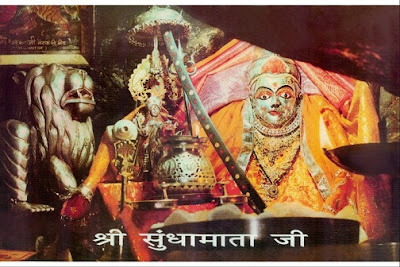
Sundha Mata

Jai Sundha Mata

Sundha Mata temple is about 900 years old temple of Mother goddess situated on a hilltop called 'Sundha', located at Longitude 72.367°E and Latitude 24.833°N, in Jalore District of Rajasthan. It is 64 km from Mount Abu and 20 km from the town of Bhinmal.

Tanot Mata Mandir

Tanot Mata Temple, about 180 Kms from Jaisalmer near Pak Border. Tannot Mata is a temple in western State of Rajasthan in District Jaisalmer of India. The Village is close to border with Pakistan and is very close to the battle site of Longewala of Indo-Pakistani War of 1971.

Sundha Mata

Sundha Mata temple is about 900 years old temple of Mother goddess situated on a hilltop called 'Sundha', located at Longitude 72.367°E and Latitude 24.833°N, in Jalore District of Rajasthan. It is 64 km from Mount Abu and 20 km from the town of Bhinmal.

Jai Sundha Mata

Sundha Mata temple is about 900 years old temple of Mother goddess situated on a hilltop called 'Sundha'.

This is default featured post 5 title

PGo to Blogger edit html and find these sentences.Now replace these sentences with your own descriptions.This theme is Bloggerized by Lasantha Bandara - Premiumbloggertemplates.com.

Tuesday, September 27, 2011

Sundha Mata : Purnima Mela -01

Purnima Tithi


Kartik Poornima

Kartik Poornima (Kartik purnima) is a Hindu holy day celebrated on the full moon day or the fifteenth lunar day of Kartik (November–December). It is also known as Tripuri poornima and Tripurari Poornima. It is sometimes called Deva-Diwali or Deva-Deppawali - the festival of lights of the gods. The Kartik Purnima festival also coincides with the Sikh festival of Guru Nanak Jayanti.

Kartik Poornima is closely associated with Prabodhini Ekadashi which marks the end of Chaturmas, a four-month period when Vishnu is believed to sleep. Prabodhini Ekadashi signifies the awakening of the god. Chaturmas penance ends on this day. Many fairs that begin on Prabodhini Ekadashi end on Kartik Poornima, Kartik Poornima usually being the most important day of the fair.[3] Fairs that conclude on this day include Prabodhini Ekadashi celebrations at Pandharpur and Pushkar Fair. Kartik Poornima is also the last day to perform Tulsi Vivah ceremony that can be performed from Prabodhini Ekadashi.

In Pushkar, Rajasthan, the Pushkar Fair or Pushkar mela commences on Prabodhini Ekadashi and continues till Kartik Poornima, the latter being the most important. This fair is held in the honour of god Brahma, whose temple stands at Pushkar. A ritual bath on Kartik Poornima in the Pushkar Lake is considered to lead one to salvation. It is believed circling the three Pushkars on Kartik Poornima is highly meritorious. Sadhus gather here and stay from ekadashi to full moon day in caves. About 200,000 people and 25,000 camels assemble in Pushkar for the fair. Pushkar fair is Asia's largest camel fair.

A ritual bath at a tirtha (a sacred water body like a lake or river) at a pilgrimage centre is prescribed on Kartik Poornima. This holy bath is known as "Kartik snana".[3][11] An holy bath at Pushkar or in the Ganges river, especially at Varanasi is deemed as most auspicious. Kartik Poornima is the most popular day for bathing in the Ganges at Varanasi.[4]

Annakuta, an offering of food to the deities, is held in temples.[3] People who have taken vows on Ashwin full moon day, end them on Kartik Poornima. God Vishnu is also worshipped on this day. Any form of violence (himsa) is prohibited on this day. This includes shaving, hair-cutting, cutting of trees, plucking of fruits and flowers, cutting of crops and even, sexual union.[11] Charity especially donation of cows, feeding of Brahmins, fasting are religious activities prescribed for Kartik Poornima.[4]

Tripuri Poornima is only next to Mahashivratri, amongst festivals dedicated to Shiva worship.[5] To commemorate the killing of Tripurasura, images of Shiva are carried in procession. Temple complexes in soutern India are lit up throughout the night. Deepmalas or towers of lights are illuminated in temples. People place 360 or 720 wicks in temples, to secure escape reaching hell after death.[3] The 720 wicks symbolizes the 360 days and nights of the Hindu calenadr.[4] In Varanasi, the ghats come alive with thousands of diyas (brightly-lit earthen lamps).[4] People gift lamps to priests. The lamps are kept throughout the night in houses and Shiva temples. This day is also known as "Kartik Diparatna" - the jewel of lamps in Kartik.[5] Lights are also floated in miniature boats in rivers. Lights are placed under Tulsi, Sacred fig and Amla tress. The lights in the water and under trees are believed to help fishes, insects and birds who saw the light to attain salvation.[11]


Sundha Mata: View in Navratri -01

Temple view in Navratras


Happy Navratri to all Mata's Devotee


Navratri, Navaratri, or Navarathri (Sanskrit: नवरात्रम्; Tamil: நவராத்திரி, Hindi: नवरात्रि, and Nepali: नवरात्रि;Marathi: नवरात्र;Bengali: নবরাত্রি; Gujarati: નવરાત્રી; Kannada: ನವರಾತ್ರಿ; Telugu: దుర్గా నవరాత్రులు; Malayalam: നവരാത്രി) is a Hindu festival of worship of Shakti and dance & festivities. The word Navaratri literally means nine nights in Sanskrit, nava meaning nine and ratri meaning nights. During these nine nights and ten days, nine forms of Shakti/Devi are worshiped. The 10th day is commonly referred to as Vijayadashami or Dashera.

Sunday, September 25, 2011

108 Devi Maa -02

Mahishasura Mardini Maa


Vaishno Devi Maa

Santoshi Maa

Skanda Mata

Savitri Maa

Sailaputri Maa

Saraswathi Mata

Ganga Maiya

Karni Mata

Chandra Ghanta Devi

Bharat Mata

Gayatri Mata

108 Devi Maa -01


Maa Durga


Maa Sundha Mata

Bhawani Mata

Maa Laxmi Devi
Maa Harshidhh Mata

Gadavari Mata


Brahmani Mata
Brahmacarini Mata


Amba Maa


Chamunda Maa

save

Jai Mata Di.....

ll JAI MATA DI ll


  • Jai Maa Chamunda.
  • Prem Se bolo Jai Mata Di
  • Sundha Maa Tera dham nirala teri Jai ho
  • Jai Mata Di...
  • Jai Sundha Mataji
  • MA KA JAKARA HO
  • जय माँ सुन्धा
  • Jai Sundha Chamundaye Matki Jai
  • Chalo Sundha Maa re dham...!!!!!!!!!!
  • Jay Maat Bhavaini Chamunda
  • Sundhawali ki.. Jay ho...............
  • Sundhaji Mata ki jay ho...
  • Hath jod sir dhru namu varamvar.
  • He jagdmba sundha maa thane koti koti prnam
  • Tum basi ho kan kan andar maa hum dhund te reh gaye mandir me........
  • Jai bolo sundha mata ki jai ho
  • Jai Jai Maa.


save

Sundha Mata -02

Jai Sundha Mata

( श्री सुंधा माताजी )

ll JAI MATA DI ll

=


Tanot Mata -03


Tannot Mata is a temple in western State of Rajasthan in District Jaisalmer of India. The Village is close to border with Pakistan and is very close to the battle site of Longewala of Indo-Pakistani War of 1971. The tourists cannot go beyond this temple to see the Indo Pak Border unless one has got the permissions in advance from the District and Military Authorities. It is now a tourist destination in India. The area is said to have oil and gas reserves. It is said that during the Indo-Pakistani War of 1971, Pakistani Army dropped several bombs targeting the temple but none of the bombs could fall on the temple and large no. of the bombs in the vicinity of the temple did not explode. After the war the temple management was handed over to Border Security Force of India. On date Border Security Force Jawans (soldiers) man the temple.

The temple has a museum which has collections of the unexploded bombs dropped by Pakistan. As per Indian Census, The Population of Tanot Village is 492 Persons having 49 Household. The place being closer to Pakistan Border and totally Unfertile Plain land is prone to enemy attacks. The Govts. of both countries have planted several Land Mines in the area. The animals like Camel, Cattle are the worst sufferer of these Land Mines.

The temple is approx. 180 km from the City of Jaisalmer and it takes approx three hours by road. The area is a high windfall area and as such large no. of wind turbine projects have come up in the area. The road to Tannot is surrounded with miles and miles of sand dunes and sand mountains. The temperatures in the area can go up to 49 deg C and ideal time to visit the place is from November to January. The geographical coordinates of the place are Latitude : 27 48' 00 and Longitude : 70 21' 00.


Tanot Mata-02

Tannot Mata Temple, about 180 Kms from Jaisalmer near Pak Border. Tannot Mata is a temple in western State of Rajasthan in District Jaisalmer of India. The Village is close to border with Pakistan and is very close to the battle site of Longewala of Indo-Pakistani War of 1971. The tourists cannot go beyond this temple to see the Indo Pak Border unless one has got the permissions in advance from the District and Military Authorities. It is now a tourist destination in India. The area is said to have oil and gas reserves.

It is said that during the Indo-Pakistani War of 1971, Pakistani Army dropped several bombs targeting the temple but none of the bombs could fall on the temple and large no. of the bombs in the vicinity of the temple did not explode. After the war the temple management was handed over to Border Security Force of India. On date Border Security Force Jawans man the temple. The temple has a museum which has collections of the unexploded bombs dropped by Pakistan. During the Dussera ( Navrathri) lot of people visit this place. The BSF runs food cafe and small shops for general public need during this time, as nothing is available normally.

[Enemy's unexploded live bombs...at "TANOT TEMPLE"]

Jai Tanu Devi Jai Tanot Mata.

Tanot Mata Temple-01

श्री तणोट राय मंदिर

श्री तणोट राय मंदिर : श्री तणोट राय मंदिर स्थान भाटी राजा की राजधानी थी वह मातेश्वरी के भक्त थे ! उनके आमंत्रण देने पर महामाया सातों बहने तणोट पधारी थी , इसी कारण भक्ति भाव से प्रेरित होकर राजा ने एक मन्दिर की स्थापना की थी , वर्तमान मे यह स्थान जैसलमेर नगर से १२० की.मी पशिचम सीमा किशनगढ़ रोड पर बना हुवा हें ! जो भारतीय सेना बी. एस. ऍफ़. जैसलमेर राज घराना व खाडाल के ग्रामो का मुख्य आस्था केन्द्र हें बड़ा ही भव्य रमणीक मन्दिर हें !

कहते हें सन १९६५ मे पाक सेना का पड़ाव था लेकिन मातेश्वरी की कृपा से किसी भी सैनिक के कोई खरोच भी नही आयी ! उल्टे पाक सेना की पुरी ब्रिगेड आपस मे लड मरी , उस सेना का ब्रिगेडियर यह माजरा देखकर विसमित हो गया वह मन ही मन इस देविक चमत्कार से मुसलमान होते हुवे भी भी श्रद्धा से मनोती मानने लगा व माता की शरण ग्रहण करने पर उसके प्राण बच गये पुरी ब्रिगेड ख़त्म हो गई उकत अधिकारी मैया का भक्त बन गया ! कुछ समय बाद मे पासपोर्ट से भारत आया तणोट राय की पूजा अर्चना कर पश्चिम सीमा पर दोनों मुल्क मे शान्ति बनी रहे , ऐसी कामना करके अपने वतन को लौट गया !

इस प्रकार माताजी कितनी दयालु हें जो उसे पुकारता उसे शरण व अभय कर देती हें ऐसे चमत्कारों से वसीभूत होकर बी. एस. ऍफ़. के कर्मचारी व अधिकारी तो मैया की अनन्य भगत बन गये प्रत्येक कंपनी जहा भी रहती हें सर्वप्रथम मैया का छोटा मोटा स्थान बना कर नियमित पूजा होती हें नवरात्री के दिनों मे बड़ा भव्य मेले का आयोजन होता हें ! अनेको यात्री आते हें इस प्रकार मुख्यालय से तणोट राय आवागमन के साधन नव दीन तक निशुल्क बसे चलती हें ! बी. एस. ऍफ़. के फोजी भाई तो धन्य हें जो सीमा की निगरानी करते हुवे मैया के प्रति अटूट श्रदा से सेवा पूजन करते हें , कोई मन्दिर मे सफाई का कार्य करते हें , कोई लंगर सँभालते हें और कई गाना बजाना करते हें ! कितने यात्रियों की सेवा मे जुट जाते हें , हमेशा लंगर भोजन का आयोजन होता हें ! मैया के भजन कीर्तन चलते रहते हें , धन्य हें मैया व भक्त फोजी भाई !!!!


यह युद्ध १६ नवम्बर , १९६५ को हुवा था, तनोट चारो और से घिर चुका था ! कर्नल जय सिंह राठोड़ (थैलासर) बीकानेर के नेतृतव मे केवलतीन सो सैनिक थे ! शत्रु ने तीन तरफ़ से धुहादार हमला कर दिया था ! हमारे जवान निरंतर लड़ते रहे ! दुसरे दीन एक जवान मे भगवती काभाव आया कि घभरावो मत तुम्हारा बाल भी बाका नहीं होगा ! हुवा यही तनोट राय कि कृपा से भारतीय सेना के किसी भी जवान को कोईचोट नहीं आयी, और शत्रु फौज हतास होकर पॉँच सो शव छोड़कर भाग खड़ी हुयी ! आश्चर्य इस बात का हे कि मंदीर की आसपास ३००० बमबरसाए गए , मंदीर मे एक भी खरोच नहीं आयी , उनमे से कुछ बम आज भी मंदीर मे पड़े हे !

save

Tuesday, August 30, 2011

Jalore-02: Guide


1. Introduction of Jalore district : name, location, area, construction of the present form, shape, geological structures- ancient alluvial plain, alluvial plain, ground sand, granite and rayolait mountains, flow system- Luni, Jwai, Sukdi, Khari, Bandi, Sagi, climate, Soils, sand mounds deposition, saline and alkali Soils.

2. Human habitation : Distribution and population growth, rural and urban distribution, ten-year changes, classification of villages according to population, population density, sex ratio, SC and ST population, literacy, literacy rate, working population.

3. Administration : Administration at the time of independence, judicial and administrative restructuring, the current administrative system, magistrates, revenue development, Panchayati Raj, police, public relations.

4. Development : Land use, Agriculture, millets, wheat, barley, maize, gram, pulses, sesame, mustard and Raidha, peanuts, other oilseeds, spices, Isbgol, fruit, vegetable, fruits. Irrigation, Dams, Bankli dam, Bithan dam, Chitalwana dam, Chavarcha dam, gauge of dams, Animal husbandry, Electricity, Transport, Roads, Railways, Education.

5. Construction of Maru and Dhanwa lands : Opinions of Abul Fazal, Col. Tod and other scholars, Opinions of Pandit Ramkaran Asopa and Acharya Parmeshwar Solanki, descriptions in Valmiki Ramayana, Medicines of region, two oceans of east and west, samvartak agni and flood, opinion of Pandit Bhagawat Dutta, flow area of Saraswati river.

6. Ancient history : Luni river civilization, Rangmahal civilization, Ahadh civilization, red and black pottery, copper and bronze tools, bone relics of dead animals, Indus Valley civilization, relics of first century AD, regional coins, Roman amphora.

7. Mythological context : Mnu smriti, Dhundumara the mythological narrative, Yadav's and Drauhu's rule, the ashram of Rishi Jabali, Lord Vishnu and Lakshmi's arrival in Srimal region, by Lord Shiva tells Gautam Rishi the location of Trayambak lake, arrival of Bharadwaj, Vashishtha, Narada etc. Bkasur slaughter by Chamunda, Ravana defeats Kubera and arrival of Kubera in Srimal, arrival of Gautam and Markandey, Lord Rama rests in Ramsin, Balrama and Lord Krishna go to Indraprastha from Dwarkavia via bhadrajun, routs during Panini's period, Shalv settlements, Ajurn marries Subhadra, Awantika, Mahajnpd period, Avnti State and Cndpradyot, Watsraj Udyan, ancient Indian's legends in Jain litrature, Nand regime, Shishunag regime, Mahapdmnand's rule in Magadh, correct date of Mahabharata period, Gita's verses found in pyramids of Egypt, Aryan mystery, Chandragupta Maurya and Alexander, Pushpgupt and Tushasfa.

8. Foreign rulers : Greek rulers, Dimatriys or Minandr's attack on Madyamika, Pusyamitra Sung, Sithiyn, Junagadh record, Bhinmal coins, Baori construction in Bhinmal city, Karkandhu and Shakandhu, Yuchi, Hunganoo, Shak dweep, entry of shakas into India, Kshaharat descendants, Bhumk, Nahapan, Satavahana, defeat of Kshaharats. Chashtan descendants, Andhau records, Jaydaman, Rudradaman, double rule system, Rudradaman's successor, Damjad or Damaghasd, Jivadaman, Rudrasinh first, Rudrabhuti, Rudrasen first, Sinhdamn, war against Malvas, Damsen, Yashodaman, Vijaysinh and Vijaysen Damjad Bhrirt Daman, Ssanian occupation, society during Shak rule, economic system, colonization in Yav dweep and Suvarn dweep, Prakrit and Sanskrit inscriptions.

9. Gupta Dynesty : Chandragupta II's victory over Rudrasinh IIIrd, Dates of Rudrasinh III's coins, silver currencies of Chandragupta II, Gupta period architecture and art from Bhinmal elegance, the wrangling of dates.

10. Huns : Hun currencies from Jalore, description of Kanhdde prabandha, description of Kuvlymala of Udyotn Suri, invasions of Torman, Mihirkul, description of Huentsang, war between Narsinhgupta Baladity and Mihirkul, betray against King of Kashmir, capturing of Gandhara, defeat against Yashovrmn of Malwa, Mandsaur records, downfall of Huns, war against Turks and Rajputs, Hun influence, destruction and massacre.

11. Gujjars: Opinions of General Kaningham, B. A. Smith, James campbell and Devdutt Ramakrishna Bhandarkar, origination from Khajars, relation with white Huns, establishment of capital in Bhinmal, criticism of foreign scholars by Ojha, Gujjar Pradesh, Huentsang's Bhinmal visit, Pratihar Bhojdev's donation plate and the inscription of Kalinjar, expansion and contraction of Gujjar's borders, Gurjjars's downfall, Kalchuri donation plate of Chalukya Samanta Pulkeshi, capture by Chawdas.

12. Chawdas : Bhinmal the most ancient kingdom, Kingdoms of Vadhwan and Anhilvadha, origin, donation plate of Dharanivarah, origin from Shankar's bow, Col. Tad's opinion, Ojha's opinion, Vasantgadh inscription, Razzil the knight of Warmlat, Shishupal slaughter, description by Bramhagupta, Nishith Cuarni, Arab invasion, description in Ftuhl-Bldan, fall of chawadas by Pratihars.

13. Fall of ancient Kshatriyas and rise of Rajputs : Harsha's death, the establishment of Delhi Sultanate, legends, Opinions of Col. Todd, Smith, Crooke and Bhandarkar, descendants of the the ancient Kshatriyas, Kshatriyas of Rajasthan, mixed blood, foreigners added into Indian society by Hribdra Suri in Bhinmal, Mount Abu Conference, Rajputs split, Jalor during Rajput regime, Navkoti Marwar, religion, education, literature, language, script, Khalji attack.

14. Gujjar Pratihar : Empire expansion, the origin, opinion of Kennedy, Kaningham, Beular, Harnle, R. C. Majumdar, Bhandarkar, Ojha and other scholars, description by Huentsang, Gwalior records, Vidwshal Bhanjika, description by Bramhagupt, Jodhpur and Gkatiyala inscription, Sanjan copper plate, Tad's opinion, Bhinmal or Jalor as capital, description in Vividh teertha kalp, Jalor Branch of Pratihars, Nagbhatt first, Devaraj, Watsraj, defeat of bhandis, defeat of Watsraj by Dhruv, creation of Kuvlymala, Nagbhatt II, attack by Govind third, defeat of Chakrayudh, defeat of Dharmpal, Nagbhatt II's political achievements, Rambhadra, achievements of Mihir Bhoj first, Mahendrapal first, Bhoj II, Mahipal first Mahendra Pal II, Devpal, decline of Pratihars, powers and services of Pratihars, key administration officials, provincial government, source of revenue, military, police and justice system, society, marriages, education, religion.

15. Parmar : Munj, Parmars from Jalor Genealogy, origin, early king's, birth story of Munj, Munj's achievements, capturing of by Bhinmal by Munj, Chandan, Devaraj, Durlbhraj, Ropsi copper plate and inscriptions, Sindhuraj, Bhoj, Sanskrit school Jalor, Krishnraj, Udayraj, Someshwar, Jai, Salakha, Kunbhatpal, capturing of Jalor by Kirtipal, administration, state officials, Ministers, Mandal, Samnti system, military, revenue, justice and police, art and literature.

16. Chaulukys : Chauluky or Solanki, Chandravanshiy kshatriyas, Mulraj first, Sanchor becomes the capital of Gujarat, Bhim first arrests Krishnraj, Chamundraj, Durlabhraj, Bhimdev first runs away from Sanchor due to Gajnavi's fear, Karn, Jai Siddhraj, Janachary Hemchandra the courtier of Siddharaj, Kumarpal and its achievements, religion.

17. Dahiya : Nansi Mutha's description, reconstruction of Jalor fort, James, Todd's description, Kewaymata inscriptions, error in Nansi's description.

18. Chauhan : origin of Chauhans, Agnivanshiy, Sewadi inscription, Ikshwaku Vanshiy, Brahmin Vanshiy, original location, Chauhanon invasion of Jalore, Sonagra Chauhan, Kirtipal captures jalore, other achievements of Kirtipal, Smarsingh, Udaysingh, Chachigdev, Samantsingh, Kanhaddev, Alauddin's Gujarat campaign, victorious Muslim army's camp at Sankarna, initial clashes, Mongols resistance, salvage of Sumaya Mahadev by Kanhaddev, legend given by Nansi, Kandhal goes to royal camp, Khalji again invades Jalor in 1305AD, Panju's story, princess Satai insists Viram to marry, collapse of Siwana, Khudala victory of Rajputs, the final attack, fall of fort, Johar by the queens of Kanhddev, Kanhaddev disappears from battle, sacrifice of Viramdev. Administration of Sonagaras, King, Ministers, military, feudatory, local government, Panchkul, society, religion, philosophy and thinking process, Sati dharm, kesaria, respect of scholars, Women's place in society, Surya, Vishnu, Shiva and Shakti worship.

19. Other Chauhan dynasties of Jalor area : Sanchora Chauhan, Boda Chauhan, Kampalia Chauhan, Deora Chauhan .

20. Muslim period : Kamaluddin Gurg and Mahmud Hoshang, Malik Dawood, Sonagras to reoccupy, Pompabai, Bihari Pathan, Malik Khurram, Yousuf Khan, Hasan Khan, Usman Khan, Buddan Khan, Ghazni Khan, Sikander Khan, Sher Shah Suri, Blochi Pathan, Malik Khan, Maldev, Taj Khan, Ghazni Khan II, Pahad Khan, Khurram, Sursingh and Gajsingh, Sisodia Bimsingh, Mirkhan, Rajakhan, Mughal emperor Aurangzeb declares jalore as Khalsa, Fataehakhan, Bahalol Khan, Syed Qasim, Dewan Kamal Khan.

21. Rathore: Origin, Rathores of Marwar, Rao Sihaji, Teedaji, establishment of state of Mndor and Jodhpur, Maldev, Chandrasen, Motaraja Udaysinh, Sursinh, Gajsingh, Jaswant Singh, Ajitsingh, Abhaysingh, Ramsingh, Bakhatsingh, Vijaysingh, Bhimsingh, Mansingh, Takhatsingh, Jaswant Singh II and his heirs.

22. Details of Parganaes : administrative operations, Pargane or hukumats, Courts of Hakims, restructuring of the judicial structure, Jalore, Jaswantpura and Sanchore hukumats, land rights, Jagirdari Rekchakri, lag-bag.

23. Freedom : Marwar Hitkarini sabha, disobedience movement of Youth leeg, civil liberties union, Marwar Lok Parishad, Jodhpur Government Act 1944, Hanuwantsingh, Mohammed Ali Jinnah, Sardar Patel and Mount Betan, after independence, United State of Greater Rajasthan, Marwar tenancy act, land revenue Act of Marwar, construction of Jodhpur division and Jalore district, Collector and Magistrate.

24 Cultural heritage : background, painting, sculpture, architecture, literature, literature of modern times, folk literature, folk beliefs, folk gods, folk dance, Mamaji ke Ghore.

25. Tourism : Jalore fort, artillery, Jaswantpura Hills, Sire Mandir, Mahadev Jagnath, Sewada of Pataleshhwar, Nilkantha Mahadev, Apeshwar Mahadev, Modran Ashapuri Temple, Sundha Mata Temple, Temple of Warahshyam at Bhinmal, Mandoli temple, Nndishwar shrine, major fairs, industrial landscape